Tom Bruno / ACE
ACE, the African Context Engine
Checked, local, citable knowledge for Africa, on any phone (USSD, SMS/RCS, voice, WhatsApp and MCP). ACE answers in 32 languages across 34 African countries, from English, Swahili and French to Hausa, isiZulu, Amharic and Tigrinya.
Every answer names the published source or dated dataset it came from. Emergencies get the caller's own national numbers before anything else runs. It works with no AI model at all.
Six decision services on public data, from rain this week to the nearest health facility, work in every country wherever the data exists, and name the gap wherever it does not.
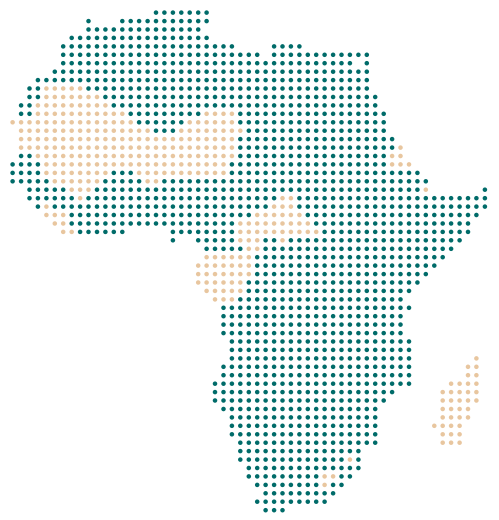
34 countries, from Tunisia to South Africa and from Senegal to Somalia
The caller's dialling code picks the country, so every answer carries that country's own emergency numbers, topics and language.
- Served by ACE
- Not yet covered
Almost a billion Africans live within reach of mobile internet and still do not use it
Mobile broadband covers 92% of Africa's population, yet only 28% of people use mobile internet on their own devices, according to the GSMA's Digital Africa Index 2026. That leaves 64% of Africans within reach of the network but not using mobile internet, almost a billion people. AI that needs a smartphone, an app and a data plan does not reach them. A short code, a text message and a phone call still do.
Services such as Digital Green's FarmerChat, Jacaranda Health's PROMPTS and MTN Rwanda's Miss Baza show the demand. Each one rebuilds its own knowledge, channels and safety layer, and the knowledge stays locked inside. ACE is the shared, open layer underneath.
Read more in two essays: AI for Africa has to work on the phone people already own and Africa's farm data is open. The last mile to farmers is the work left to do.
Six things ACE does today
Answers on the phone people already own
USSD, SMS and voice come first, because they reach every phone with no app and no data: a USSD menu where every screen fits, SMS replies within three segments and a keypad voice line. People with a smartphone and data can choose WhatsApp, or RCS where their carrier supports it, to see the sources under every answer, with suggested replies on RCS. RCS falls back to SMS, so a reply never depends on RCS.
The right emergency number
A message about a medical emergency, poisoning, violence, child abuse or self harm, in any of the 32 languages, gets the caller's own national numbers and a human handoff before anything else runs. ACE never gives a number from another country, and where no public source publishes one, it does not invent it.
Mobile money scams
Forward a suspicious mobile money message and get an explained verdict. In Kenya it cites Safaricom's own guidance; elsewhere it gives no number it cannot cite. It never tells anyone a message is safe.
Advice people can trust
Crop pests and diseases, maize storage, danger signs in pregnancy and antenatal checks, drawn from WHO, FAO, CIMMYT, CABI, IITA, ICIPE and KALRO guidance. Every answer names its source, and draft or expired facts are withheld by default.
Grounding for AI assistants
Any AI assistant can ask ACE for cited African context, scam checks and emergency numbers. When a language model writes the reply, ACE checks it stayed with the facts and falls back when it did not.
Privacy by design
Phone numbers are stored only as salted hashes. One word, such as FORGET, FUTA or OUBLIER, deletes everything ACE holds about a person. Community tips wait for expert review and are never served until checked.
One engine behind every channel, and safety runs first
Thin adapters turn each channel into one message type. The engine keeps one pseudonymous profile per person across channels, runs the safety rail, then commands, Scam Shield, the V2 decision services and retrieval over sourced context packs, and composes an answer that fits the channel.
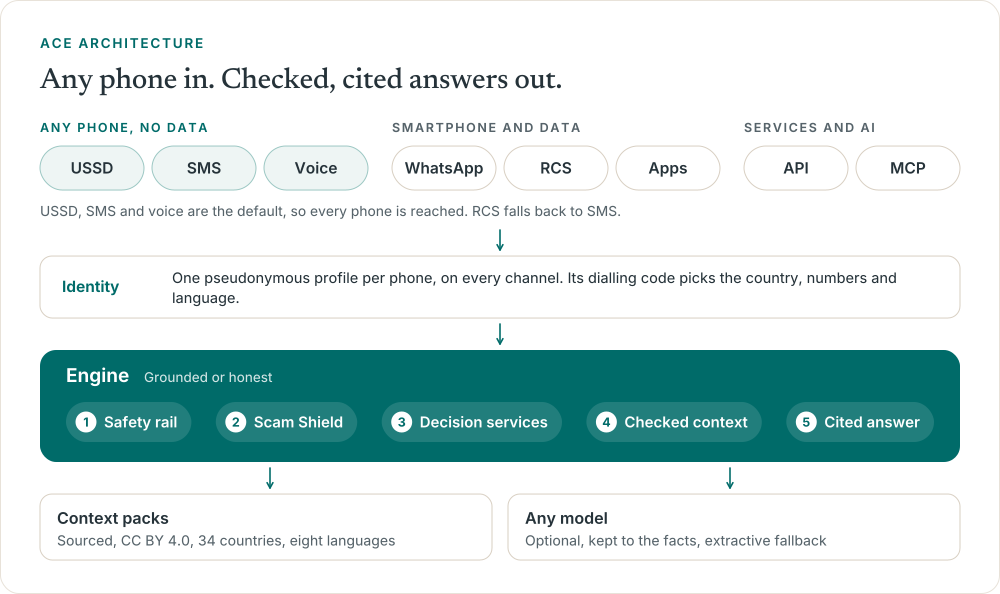
Grounded or silent
Nothing reaches a person unless it comes from a checked fact, a dated snapshot or is a fixed system message.
Honest about gaps
When no checked fact matches, or a country has no data for a service, ACE says so and names who to ask.
No lock-in
Python standard library plus PyYAML. Any OpenAI compatible model server works, including models you host yourself.
34 countries, one engine, and every caller gets their own country's emergency guidance
The caller's dialling code picks the country, so the emergency numbers, topics and default language always fit that person. Release 2.4.2 holds 98 facts across 41 packs, each checked against a published public source in November 2026, plus dated snapshots of public data for every country.
- Kenya +254
- Tanzania +255
- Uganda +256
- Rwanda +250
- South Africa +27
- Botswana +267
- Namibia +264
- Zimbabwe +263
- Nigeria +234
- Ghana +233
- Senegal +221
- Côte d'Ivoire +225
- Togo +228
- DR Congo +243
- Malawi +265
- Burundi +257
- Cameroon +237
- Benin +229
- Zambia +260
- Chad +235
- Guinea +224
- Burkina Faso +226
- South Sudan +211
- Ethiopia +251
- Mozambique +258
- Guinea-Bissau +245
- Angola +244
- Somalia +252
- Sudan +249
- Algeria +213
- Egypt +20
- Libya +218
- Morocco +212
- Tunisia +216
Every emergency number expires after a year, and a number watcher rechecks each one against its source every week. Guinea and South Sudan have no national emergency number, so ACE says so and sends people to the nearest health facility. Every rendering in a language other than English awaits review by fluent speakers, and the 24 languages added in release 2.3 are drafts. The full table of numbers and sources is in the README.
Six decision services now answer from public data across 34 countries, and name the gap where data is missing
ACE turns public weather forecasts, official warnings, facility lists, market prices and WHO guidance into short, cited answers on any phone. Each service covers every country wherever open data exists and names the gap where it does not. Release 2.1 added 21 countries, five languages, and replies sized for the alphabet each language travels in, and release 2.3 added 24 more languages. The safety rail still runs first, and every answer carries its source and date.
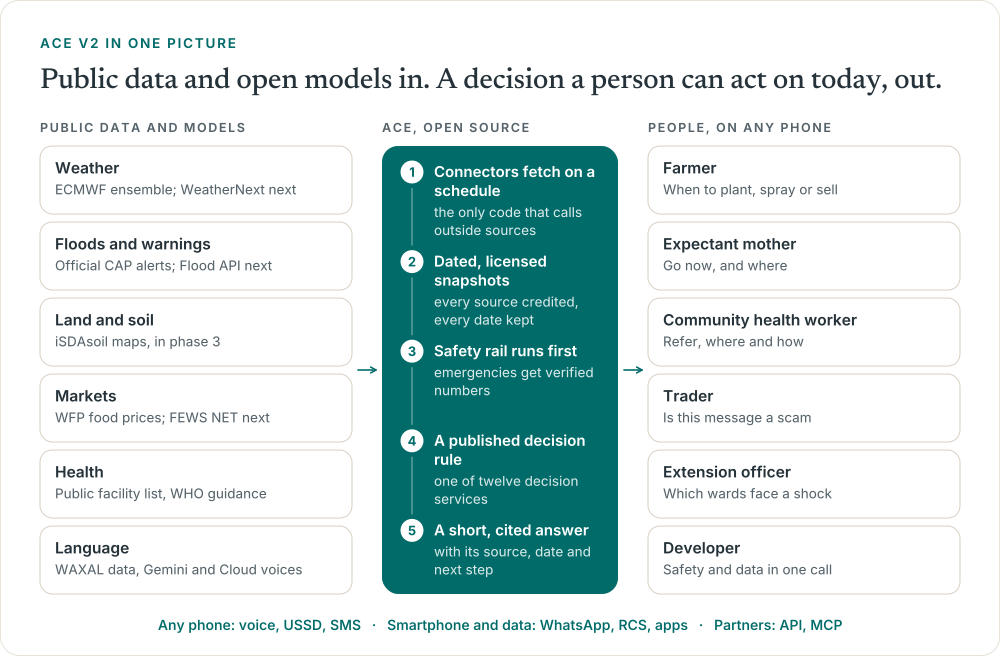
- Rain this week
- Official warnings
- Nearest health facility
- Market prices
- Pregnancy companion
- Crop problem check
The services are a preview until they pass expert review, forecast skill and fluent speaker gates. The gaps are named in each answer: rain, the pregnancy companion and the crop check work in all 34 countries, official warnings in 29, the facility finder in 29 (the open list stops at the Sahara) and market prices in 23. Still to come: the planting window, soil advice, flood forecasts, Scam Shield 2, health worker assist, spoken replies in Afaan Oromo, and speech recognition tuned on WAXAL. Read the 2.1 design, the services guide, the product spec and the build plan.
ACE is tested on real African speech, says when it does not read a language, and speaks 19 languages by voice
ACE runs its language guess, safety rail and service router on 12,333 sentences of real speech text from WAXAL, the open African speech corpus from Google Research and seven African partners, each read as from a country where its language is spoken. ACE recognises nine of its languages, from Hausa and Igbo to Shona, Luganda and Amharic, in 94% to 100% of those sentences, and Yoruba in 92%, while Fula, Lingala and Nigerian Pidgin stay at 69% to 77%, most misses read as French, Swahili or English, and the safety rail fired on 6 ordinary texts out of 12,333, among them two stories in which a snake bites and a news report of a drowning. Across 12 languages it does not speak, ACE now tells the writer so in 46.5% of sentences, names the languages it reads in their country and gives the emergency numbers, instead of answering in one they may not read. The voice line reads six languages with Google Cloud voices and plays 13 more with Gemini 3.8 Flash TTS.
Optional Google Cloud providers hear spoken questions in 23 languages, speak replies and give fluent reviewers a back translation of every string. Machine translation never answers a person. The gaps are named: Lusoga, Sidama and Wolaytta have no open text to profile, so ACE still answers them mostly in Luganda or Afaan Oromo, and 13 languages, Afaan Oromo among them, have no voice yet, so their callers get the full reply on SMS and USSD in their own language. Read the speech and translation guide and the WAXAL results.
People who know a place matter as much as people who write code
Extension officers, clinicians, midwives, agronomists and translators
Add facts to a pack, review a translation in any of the 31 languages beyond English, from Swahili and Hausa to isiZulu and Wolof, or start a pack for your county or country. No coding needed.
Write a context pack →Run it in a few minutes
# Python 3.10 to 3.13
git clone https://github.com/tbrunoh/african-context-engine.git
cd african-context-engine
pip install -e ".[dev]"
ace demo
ace serve   # the simulated phone on 127.0.0.1:8000
Pick a starter issue →
ACE stands on guidance and data published by the World Health Organization, FAO, ICIPE, KALRO, the Kenya Meteorological Department, Safaricom, the UK Foreign, Commonwealth and Development Office, national governments and regulators in all 34 countries, Child Helpline International and others. Each is credited in ACKNOWLEDGMENTS.md. A credit does not mean the organisation endorses ACE.
Questions people ask about ACE
What is ACE?
ACE, the African Context Engine, is open source software that gives checked, local, citable knowledge for Africa on any phone (USSD, SMS/RCS, voice, WhatsApp and MCP), in 32 languages across 34 countries. AI assistants reach it through MCP, and other services through its API.
Can I dial ACE today?
Not on a real phone line yet. ACE is software that a ministry, NGO, telecom or startup deploys behind its own short code, phone line, WhatsApp number or RCS agent. Anyone can try it today at ace.korext.com, a simulated phone for USSD, SMS, voice, WhatsApp and RCS, or run the same phone locally with ace serve.
Does ACE need a smartphone or mobile data?
No. USSD, SMS and voice are the default, because they reach any mobile phone with no app and no data plan. People with a smartphone and data can choose WhatsApp, or RCS where their carrier supports it, to see the sources under every answer, with suggested replies on RCS. RCS falls back to SMS, so a reply never depends on RCS; it shipped in release 2.2.0b3 and is switched on country by country. Apps and web pages can also be built on the ACE API.
Does ACE work by voice in African languages?
Yes, in 19 of ACE's 32 languages. The keypad voice line works on any phone. It reads English, Swahili, French, Portuguese, Arabic and Afrikaans with Google Cloud voices, and plays Amharic, Somali, Hausa, Igbo, Sesotho, Chichewa, Bemba, Kinyarwanda, Luganda, Lingala, Akan, Dyula and Tigrinya audio made with Gemini TTS when the operator adds a Gemini API key. Afaan Oromo, Yoruba, isiZulu and ten other languages have no voice yet, so those callers hear the next language of their country with a voice and get the full reply on SMS and USSD in their own language. Spoken questions work through Google speech recognition in 23 languages.
What if I write in a language ACE does not speak?
ACE tells you. It compares each message with letter profiles of its 32 languages and of 49 languages it does not speak, such as Gikuyu, Dholuo, Dagbani and Malagasy. A message plainly in one of those gets a short reply, in your country's language, that ACE does not read this language yet, which languages it does read there, and your country's emergency numbers. Names, place names and links are left out before ACE judges, English is read in every country, ACE languages written from a neighbouring country are read, and emergencies ACE recognises still get the emergency reply first. On real speech from WAXAL, ACE says so for 46.5% of sentences in 12 languages it does not speak, and turns away at most 0.5% of any of its own languages where it offers them.
Does ACE use a large language model?
It does not need one. By default ACE composes answers directly from checked facts, with no model and no API key. A deployment can add any OpenAI compatible model, and ACE then checks that the model stayed with the facts and falls back when it did not.
Which countries and languages does ACE cover?
34 countries: Kenya, Tanzania, Uganda, Rwanda, South Africa, Botswana, Namibia, Zimbabwe, Nigeria, Ghana, Senegal, Côte d'Ivoire, Togo, DR Congo, Malawi, Burundi, Cameroon, Benin, Zambia, Chad, Guinea, Burkina Faso, South Sudan, Ethiopia, Mozambique, Guinea-Bissau, Angola, Somalia, Sudan, Algeria, Egypt, Libya, Morocco and Tunisia. 32 languages, each offered in the countries that speak it: English, Swahili, French, Portuguese, Arabic, Amharic, Afaan Oromo, Somali, Hausa, Yoruba, Igbo, Nigerian Pidgin, isiZulu, isiXhosa, Afrikaans, Sesotho, Setswana, Xitsonga, Shona, Chichewa, Bemba, Kinyarwanda, Kirundi, Luganda, Lingala, Akan, Ewe, Wolof, Dyula, Mooré, Pular and Tigrinya.
What can the decision services answer?
Whether rain is likely each day this week in a person's area, whether an official warning is in force, the nearest public health facilities, what a food cost in the nearest market, when the next antenatal check is due, and the likely problem with maize, cassava, banana or tomato. Each answer cites a dated dataset or a sourced fact, and the services are labelled a preview until they pass expert review.
Is ACE free to use?
Yes. The code is under the Apache License 2.0, the open context packs under CC BY 4.0, the language profiles under CC BY-SA 4.0 because they are built in part from FLORES-200, and place data from OpenStreetMap under the ODbL. Third party sources keep their own rights, and each is credited. To cite ACE, use doi:10.5281/zenodo.24565737, which resolves to the latest version.
Is ACE a doctor, agronomist or bank?
No. ACE shares published guidance and tells people when and where to get human help. Its safety phrases and translations need review by clinicians and fluent speakers before a public launch, and each deployment is responsible for its own data protection obligations.
Who created ACE?
ACE was created by Tom Bruno, a Product and Ecosystem Leader in AI Ecosystems at Google, as a personal project, and is maintained with the ACE contributors.